
Share your coffee stories with us by writing to info@comunicaffe.com.
Massimiliano Marchesi, Coffee Trainer, shares his experience in the event dedicated to Italian coffee, organized by the Italian Cultural Institute of Athens for the Week of Italian Cuisine in the World. Below, we share his experience.
Italian coffee takes center stage in Athens with the Italian Cultural Institute during the Week of italian cuisine in the World
by Massimiliano Marchesi
ATHENS – “As part of the Week of Italian Cuisine in the World, now in its tenth edition, I had the pleasure and the honour of taking part in an event dedicated to Italian coffee, organized by the Italian Cultural Institute of Athens.

The initiative, held with the technical support of the Italian Coffee Roasteries Guide — partner of the Italian Coffee Style campaign promoted by the Italian Ministry of Foreign Affairs and International Cooperation — took place on Saturday, November 29, at the Institute’s splendid headquarters at 47 Patission Street. This elegant, historically rich building has represented for nearly a century a cultural bridge between Italy and Greece in the promotion of Italian heritage.
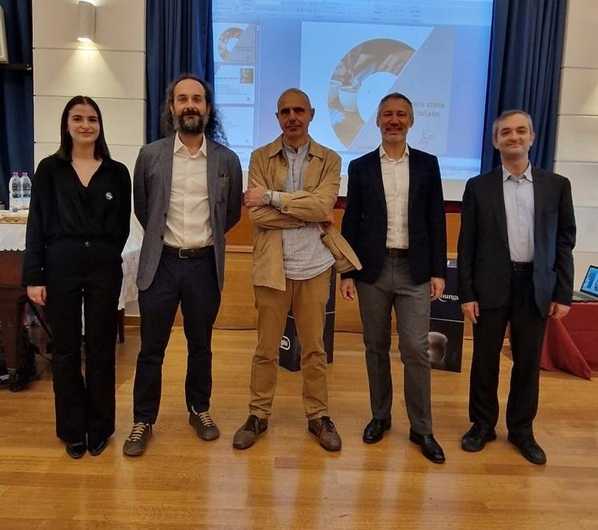
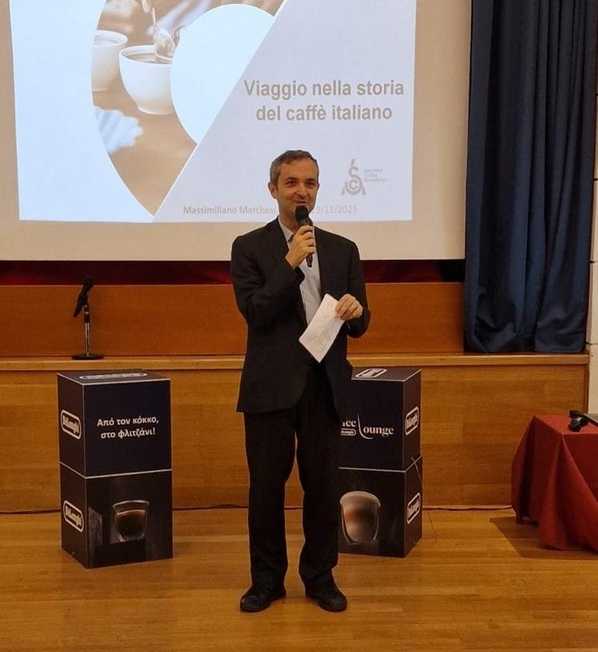
My presentation, introduced by the institutional greeting of the Institute’s Director, Francesco Neri, and delivered with the valuable technical support of De’Longhi Greece, focused on the history and evolution of Italian espresso and the moka pot. I retraced the key stages in the spread of coffee across Europe, highlighting symbolic milestones such as the opening of the historic Caffè Florian in Venice.

I described how, between the eighteenth and nineteenth centuries, coffee gradually replaced wine and spirits as an intellectual stimulant, finding its place in bourgeois salons and in the literary, political, and philosophical centre of Italian culture.
From the very beginning, the event took on a highly interactive character thanks to the lively participation of the Greek audience, which was both numerous and genuinely curious.
The many questions raised allowed me to explore topics related to home coffee preparation, proper bean storage, and to debunk some persistent myths—such as the belief that the moka pot should never be washed or that decaffeinated coffee is somehow a “second-rate” product.
To make the narrative even more tangible, I guided a tasting session featuring three different espresso coffees: a 100% Arabica blend, a blend composed of 50% Arabica and 50% Robusta, and finally a Specialty Coffee.
All extractions were carried out using De’Longhi automatic machines equipped with integrated grinders, to fully enhance freshly ground coffee and to demonstrate that it is possible to achieve a high-quality espresso even in one’s home kitchen.
The educational journey continued with a coffee pairing session that was met with great enthusiasm by the participants. I proposed three pairings: the 100% Arabica blend with a Piedmontese gianduiotto chocolate, the Arabica specialty coffee with a traditional amaretto biscuit, and finally the Arabica–Robusta blend with 24-month-aged Parmigiano Reggiano.
This last pairing, unusual yet surprising, sparked curiosity and allowed participants to perceive aromatic notes reminiscent of cappuccino and tiramisu. It provided a concrete example of how coffee can move beyond its traditional contexts—breakfast, after-meal, or coffee break—and engage in a creative dialogue with savoury foods, especially cheeses, by playing on shared sensory affinities with milk.
The event demonstrated how coffee, when communicated with passion and expertise, can be rediscovered even by a non-technical audience that consumes it daily, such as the Greek public.
The celebration of Italian espresso thus helped strengthen the perception of coffee as an identity-defining product of Made in Italy and highlighted its value as a tool for cultural dialogue, capable of promoting Italian excellence abroad.
Andrej Godina, curator of the Italian Coffee and Roasteries Guide, enthusiastically commented on the success of the Athens event: “The Guide is beginning to be used exactly as Mauro Illiano and I had envisioned from its very first edition — as a concrete tool for enhancing the Italian coffee supply chain and, at the same time, as a practical manual for professionals and consumers, helping them explore the thousands of flavour nuances expressed by Italian roasteries across the entire country. I am confident that in the coming years coffee will earn its rightful place within Italian cuisine, gaining new value and establishing itself as a true gastronomic beverage, distinguished by extraction methods and sensory profiles.”
The experience in Athens was particularly meaningful for me. I was able to share Italian coffee culture with an attentive and engaged audience, in a setting that brings together history, architectural beauty, and a deep appreciation for Italy.
Events like this confirm that coffee is far more than a beverage: it is a social ritual, a cultural element, and a powerful vehicle for connection between peoples and traditions.”
Massimiliano Marchesi