


Share your coffee stories with us by writing to info@comunicaffe.com.
PATROCÍNIO, Minas Gerais, Brazil – The coffee harvest in Brazil’s Cerrado Mineiro region is progressing well and in line with expectations, according to the Cerrado Coffee Growers Cooperative (Expocacer). As of early August, 81% of the co-op’s coffee-growing area has been harvested. Expocacer oversees 84,900 hectares of cultivated land, with 71,400 hectares in active production.
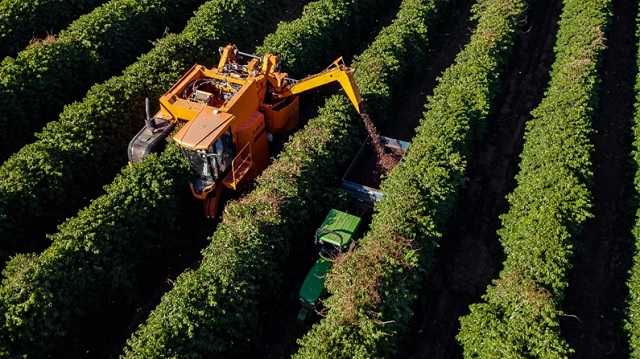
Farmers in the region continue to benefit from ideal natural conditions, such as a dry climate, flat terrain, and high levels of mechanization. Nationally, Brazil has harvested 91% of its 2025/26 arabica coffee crop, according to the latest report from the consultancy company Safras & Mercado.

The harvest is expected to continue through the end of August or early September, depending on weather conditions. “So far, the weather has been favorable, with no frosts or off-season rains that could interfere with the final stages of harvesting,” said Simão Pedro de Lima, CEO of Expocacer.
Technology drives efficiency
Innovation plays a crucial role in Expocacer’s coffee processing operations. The cooperative has invested heavily in its industrial complex, integrating robotics, AI-powered sensors, and machine-to-machine communication systems. Automated routes control the reprocessing of coffee beans, enabling precise monitoring of performance and maintenance metrics.

AI sensors track machine vibrations and temperatures in real time, helping prevent equipment failures and streamline predictive maintenance. This has already led to a 20% reduction in maintenance costs and a 10% increase in equipment availability.
Expocacer members are also embracing smart farming technologies in the field, including soil moisture sensors and weather stations that optimize irrigation and water use.
Sustainable practices
To ensure both high productivity and quality, the cooperative promotes sustainable agricultural practices, such as the use of bio-inputs, regenerative farming techniques, and expert consulting.
“Several regional factors contribute to the superior quality of our coffee. The dry weather during harvest allows for natural and uniform drying of the beans, reducing the risk of undesirable fermentation and speeding up post-harvest operations. Flat terrain also enables greater mechanization, which lowers production costs, reduces losses, and improves operational efficiency,” explains Lima.
Market outlook
Despite increased volatility on the New York Coffee Exchange, many producers are navigating the market strategically, selling portions of their crops to fulfill existing commitments, including forward contracts and barter deals.
“Even in this challenging environment, Expocacer continues to provide liquidity for its members,” said Petrônio Primo, Expocacer’s business agent. “We remain active in the market every day, offering competitive prices and personalized service, with a secure and agile transaction support.”
About Expocacer
Created in 1993 and located in Patrocínio, Minas Gerais, the Cerrado Coffee Growers Cooperative (Expocacer) promotes the quality of coffees and the work of its members in Brazil and worldwide through relevant socio-environmental initiatives and the economic development of the entire region. The cooperative’s infrastructure includes two warehouses with a capacity of over 1 million bags. Currently, it serves more than 740 producers, exporting to over 35 countries across 5 continents.