

Share your coffee stories with us by writing to info@comunicaffe.com.
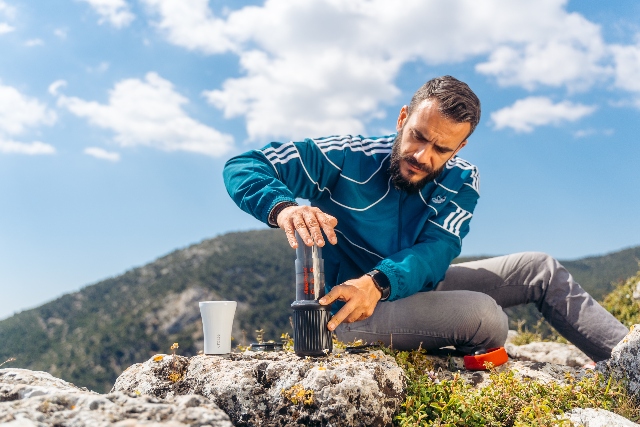
Stefanos Domatiotis is a former Brewers Cup Champion, consultant, founder of Create. He talks to Accademia Del Caffè Espresso about his coffee journey and the future of the sector. Below, we share his thoughts published directly in the Accademia Del Caffè Espresso website.
A coffee With Stefanos Domatiotis, former Brewers Cup Champion, consultant, founder of Create
MILANO – “I started working in the coffee world around 1997, when, to support myself, I took a job as a floor assistant in a coffee shop. Just a part-time gig while I was trying to figure out what to do with my life. But the more I learned, the more fascinated I became. I was quick, I knew how to organize the workflow, and soon I was asked to work behind the counter. That’s when I realized coffee wasn’t just a beverage. It had a thousand nuances, and my curiosity drove me to dig deeper.

In 2004, I won the National Barista Championship for the first time and represented Greece at the World Barista Championship in Trieste. That was when I began to understand that coffee was not just about taste, but a world where I would always be learning. In the years that followed, as I kept competing internationally, I saw firsthand how coffee is constantly evolving. Just when you think you’ve mastered something, a new technique, a new origin, or a new approach emerges—proof that there’s always more to explore. It’s like an endless journey of curiosity, experimentation, and knowledge.
And this knowledge is never fixed; it expands at the same pace as the market and the culture around it. In 2010, I competed in the World Barista Championship in London, again representing Greece, and for the first time I made it into the world’s top six baristas.

That moment strengthened my belief that behind every cup there are stories, people, and connections, and that growth comes only through continuous research and discovery.
Over the years I’ve taken on many roles in coffee: I was a barista, I competed, I became a trainer and later a consultant—the role that defines me the most today.
That’s why I founded Create: because I’m passionate about entering someone else’s world—whether it’s a café, a hotel, or a roastery—and helping them see new possibilities for their business. We can solve problems, spark creativity, and strengthen the vision of the person asking for support. This work allows me to put into practice and share everything I’ve learned over the years. But every time, I also learn something from them. That exchange is what keeps me motivated: being enriched with new experiences.
Create aims to make knowledge accessible and experiences memorable. Taste must become the common language that connects the entire supply chain, from the plantation to the cup. We want to bridge the gap between professionals and consumers, and for us, taste is the language that unites everyone. Whether you’re a guest enjoying coffee in a hotel, a barista serving behind the counter, or an entrepreneur developing a concept, taste is the starting point—it’s what connects us all. Through consulting and training, we help businesses translate the language of taste into something tangible: better menus, more efficient workflows, well-trained teams, and ultimately, more satisfied customers. Training is at the heart of what we do, but it’s never an end in itself—it’s about creating real impact.
I entered barista competitions because I wanted to test myself, to see how far passion and discipline could take me. But competitions were never just about winning. They were about growth, pushing beyond my limits, and sharing coffee in a way that could inspire others.
Winning the World Brewers Cup in 2014 changed my life. On a personal level, it was overwhelming—like years of hard work, failures, and sacrifices condensed into a single moment, into a single cup.
I still remember exactly how I felt when my name was called: a mix of joy and disbelief. It wasn’t just my victory—it felt like a victory for everyone who had believed in me and supported me along the way. Professionally, it gave me a voice in the coffee world. It opened doors, yes, but above all it gave me a responsibility: to use that platform to share knowledge, mentor others, and help people believe in themselves and in their ability to achieve their goals.
We must look to the future with positivity. If I think about current trends and imagine the future of coffee, I believe education will become increasingly practical and science-driven—because science helps us understand what’s happening in the cup, while practice helps us put that science into action. The future will belong to those who know how to balance the two, keeping coffee human and accessible.
I also believe curiosity—both from consumers and professionals—will only keep growing. People will want to know not just what determines a coffee’s flavor, but how that flavor was created. This is where science brings clarity. At the same time, coffee is also about sharing an experience, which comes through practice, touch, and connection.
Another key element for the future is communication. Having knowledge and skills is not enough—we must be able to explain coffee in ways everyone can understand: farmers, baristas, everyday consumers. The true future of education will be when science, practice, and clear, accessible communication come together. That’s when coffee can remain a source of inspiration.
Coffee professionals also carry a huge responsibility in promoting sustainability and ethical sourcing. Behind every cup there is a chain of people: farmers, pickers, roasters, baristas. If we don’t honor this chain with fairness and transparency, then what are we really doing? Sustainability is not a trend—it’s about the survival of the entire industry, which continues to be driven by extraordinary innovations.
I’m fascinated by the creativity now applied to processing: anaerobic fermentation, carbonic maceration, experimental yeast inoculations.
These methods are pushing coffee into flavor territories we never thought possible. Suddenly, you can taste tropical fruit, floral notes, or sparkling acidity in origins where you’d never expect to find them. It’s almost like writing a new vocabulary for coffee.
What excites me most is that these innovations not only create extraordinary flavors but also open up new opportunities for producers. By experimenting with processing, farmers can add value to their harvests and stand out in a competitive market. This translates into greater recognition and, hopefully, better prices at origin.
On the production side, I love the evolution of technology: precision tools, better grinders, automated systems that still respect craftsmanship. But no matter how far innovation goes, it always comes back to a simple truth: the pleasure of taste in the cup. And right now, it feels like we’re standing at the threshold of an entirely new range of flavor experiences. That’s why I remain curious. I keep asking questions, tasting constantly, and surrounding myself with inspiring people.
Coffee has this wonderful ability to remind you that there’s always something new to discover—something capable of surprising you. Traveling also plays a big role in that. Every time I visit a coffee community—whether it’s a farm, a roastery, or even a café somewhere in the world—I realize how much knowledge is out there waiting to be shared. Seeing how others approach coffee, sometimes in very simple but always very different ways, makes me humble and pushes me to rethink my perspective.
I try to maintain the mindset of a student, not just a professional. I stay open, willing to learn from anyone, and let every cup teach me something new.
If coffee hadn’t been my path, I think I would have devoted myself to painting. I’ve always loved playing with colors, textures, and shapes to express ideas and emotions. For me, painting is very much like coffee: both are creative, both are about balance, and both can tell a story without words. I would have sought that connection between craftsmanship and human expression on a canvas instead of in a cup.”