
Share your coffee stories with us by writing to info@comunicaffe.com.
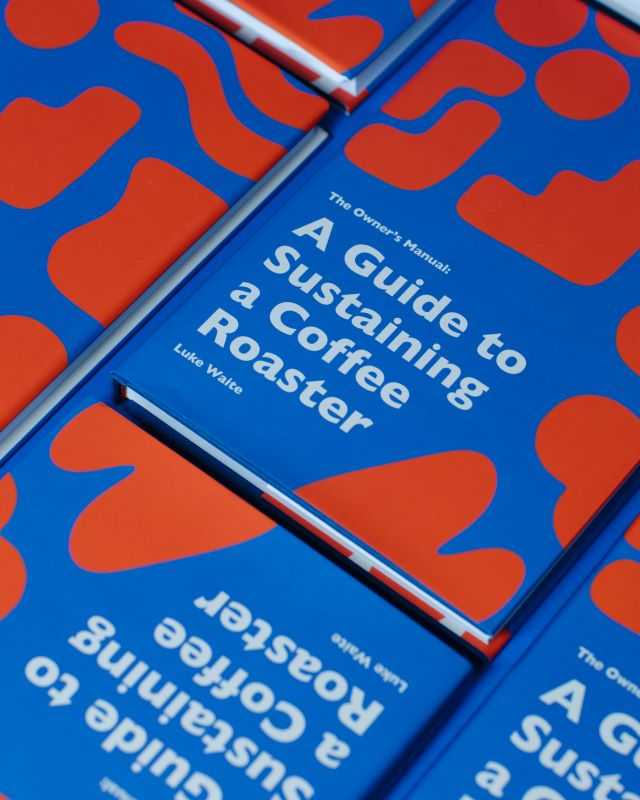
MILAN – Not just a book about coffee roasting, but finally – one might say – a practical manual on how to understand a roastery as a real business to be managed, planned, and made economically sustainable. All this and more is the content of the first book written by Luke Waite. The Owner’s Manual: A Guide to Sustaining a Coffee Roaster.
A recommended guide for anyone who really wants to pursue this career with a professional and solid management approach.

The Owner’s Manual: A Guide to Sustaining a Coffee Roaster
Suitable for anyone who already owns a roasting business and wants to give it a more systematic structure. But also for those who are thinking of starting their own business and have to deal with the fundamental aspects of a company: the numbers, a business plan that covers the commercial side of this business.
These are elements that are often romantically ignored but which often lead to the failure of the business itself, which, as the founder of Pomelo Roasting rightly points out, is in effect a company and should be treated as such.

And for a company to function, it must generate revenue.
Numbers at hand
Drawing on his experience as a consultant and therefore from his work in close contact with roasters, Waite has developed a system for micro specialty roasters to achieve the right profit.
It is necessary to come to terms with less noble issues such as income and expenditure, sales force, how to promote oneself and build an efficient sales network: this formula is defined and then explained in detail by the author as The Core 7.
These are simply seven key points around which to develop your business: Sales, Product, Cash, Green Coffee, Roastery Operations, People, and Wholesale.
Easy, right?
Not at all.
Obviously, in The Owner’s Manual, the answers are never trivial, being the result of years of field research, yet some of the concepts that underpin the initial vision are not so straightforward for most novice roasters.
The initial period before reaching true economic sustainability is difficult to deal with, but, as the author provocatively asks: “Do you run a charity?”
The good news is that success can be calculated; you just need to know how to organize the sales process, identifying your target market and future developments. Understand what CRM Management means (a tool that helps manage customer relationships).
It is essential to establish the minimum volume of coffee to be sold per week or per month in order to remain financially sustainable and then set the most appropriate price for the product sold (an operation that is by no means straightforward, warns Waite, who comes to the rescue on page 183 with a very detailed and illustrative numerical overview).
Be practical: The Owner’s Manual challenges roasters
It also makes them think about other critical issues, such as delivery times to be respected once set, bearing in mind that today people are used to services such as Amazon (hence the need to take into account the ability to deal with sudden orders and, of course, shipping costs).
If anyone has a romantic image of the roaster working alone, here’s another piece of news: part of the job is to constantly maintain contact, whether in person or by email. You cannot build customer loyalty without communicating regularly with your customers.
(Hence, another important figure to have on board is someone responsible for managing these contacts).
In practice, building up this network of loyal customers for a micro roastery’s coffee is a long, complex process that requires time and dedication. Nothing is left to chance, and The Owner’s Manual emphasizes this point repeatedly.
You need to grow as professionals and as individuals in order to develop your business accordingly: a good leader knows where they are taking their team (in fact, the author makes an interesting distinction between being owners and being good bosses).
So does passion take a back seat?
For those who feel a little disillusioned after reading this particularly pragmatic text, we recommend reading the manual to the end, to the letter dedicated to all novice roasters, who are usually fueled by a dream.
A dose of realism does not necessarily destroy the emotions behind an entrepreneurial project.
We conclude with Waite’s encouragement: “Remember, dear roaster, that you are valuable.”
The Owner’s Manual, A Guide to Sustaining a Coffee Roaster is available for purchase in digital format at this link, for $30.