
Share your coffee stories with us by writing to info@comunicaffe.com.
WEYBRIDGE, United Kingdom – Preserving aroma, easing transport, and meeting ever-stricter circularity regulations: at the latest, the PPWR puts coffee packaging under severe strain. Adding to the challenge, roasteries often have to implement increasingly stringent requirements on legacy equipment that’s sometimes decades old.
How the coffee packaging process can be modernized for the future under these conditions is explained by long-time coffee-packaging expert Wilbert van de Corput using the example of collaboration among Mondi, roasteries, and packaging machine manufacturers.

How much of a coffee bean’s unique character ends up in your cup each morning is determined in no small part by the packaging. Whether it’s a bag of whole beans, a vacuum “brick” of ground coffee, or a filter-coffee capsule: the package keeps out oxygen and moisture, preserves freshness, and conveys a brand’s character. And that’s just the start.
Beyond coffee aroma, a roastery’s environmental stewardship is becoming a decisive purchase criterion. Political pressure on sustainability is mounting as well, most recently through the new European Packaging and Packaging Waste Regulation (PPWR).

It has been in effect since February 11, 2025, and with various requirements applying from August 12, 2026 onwards, depending on the specific provision. Under it, primary and secondary packaging for foods such as coffee must meet “design-for-recycling” criteria starting from January 1, 2030. Additionally, the PPWR establishes recycling targets and extended producer responsibility requirements with various timelines through 2040.
PPWR Requirements for coffee packaging
The recyclability of packaging and materials is essential to keep valuable raw materials in circulation. To that end, the PPWR establishes a clear framework in the form of binding minimum recycled-content levels.
For the type of plastic packaging into which coffee packaging also falls, these are 10% by 2030 and 25% by 2040, respectively. In addition, PFAS limits for food-contact packaging take effect starting August 12, 2026. Regardless of material, the PPWR requires packaging minimization and harmonized labeling for material composition and sorting, phased in beginning in mid-2028.
These requirements meet the realities of the coffee industry. Some roasteries still run rugged primary packaging machines from the 1980s and invest first in end-of-line automation. Thus, the choice among paper, plastic, or aluminum depends not only on the circularity of the packaging material in question, but also on its runability on installed lines.
Against this backdrop, Mondi supports the coffee sector with solutions for a wide range of packaging formats that combine sustainability, product protection, and process reliability. Recyclable mono-materials and compostable paper capsules preserve aroma and quality thanks to high barrier properties and open pathways to circularity. Added benefits include efficient processing on existing filling lines, flexible printing options for strong shelf impact, and a Europe-wide production network that provides supply security.
Mono-PP vs. Mono-PE: There Is No One-Size-Fits-All
Anyone aiming to make plastic packaging recyclable cannot avoid mono-materials. What’s needed is a mono-material family that runs stably on the existing packaging line while also delivering robust proof of recyclability.
For coffee packages up to one kilogram, as commonly used for coffee beans, mono-PP shows its strengths on existing VFFS lines; the higher sealing temperature window of around 130–140 °C provides tolerance and stabilizes cycle rates across entire shifts. Mondi can supply pre-applied PP valves that eliminates the separate valve station.
Edge crystallization in PP remains a critical issue: large quad-seal bags tend to form hard corners with a risk of cracking. In the coffee segment, this can be controlled through more elastic structures and clean seal profiles. Mono-PE scores with better elongation and drop-test robustness for heavy sacks, but it requires tighter temperature control and reacts more sensitively to fluctuations.
The valve is where the next difference shows up: PE valves seal reliably to PE; PP valves are more demanding from a manufacturing standpoint. That’s why many transitions began with mono-PE, while today PP more often delivers better runability in bean and brick formats (for ground coffee). Ultimately, the deciding factor remains which structure runs faster and generates less trim waste on the installed line.
Compostable Packaging – Already a Reality Today
The PPWR permits, under certain conditions, packaging designed to be composted where it is disposed of together with bio-waste, such as certain coffee capsules or permeable filter bags. Compostable solutions play to their strengths where packaging material and coffee grounds are collected together.
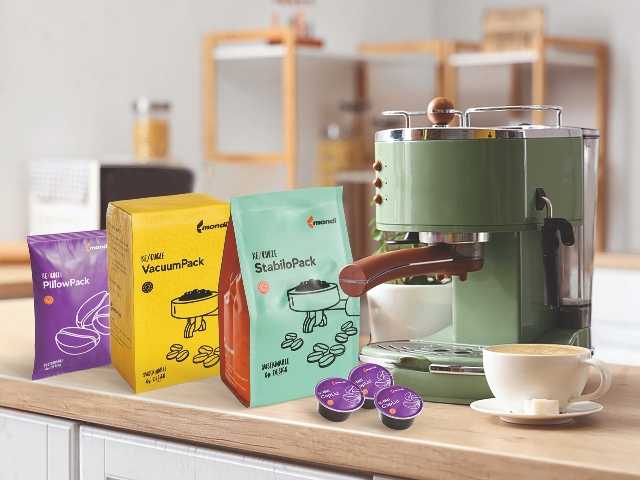
For primary packaging, the realistic route most often runs through recyclable constructions: innovative packages such as Mondi’s re/cycle VacuumPack with pre-applied valves enable high line speeds and remain consistent within the material laminate. In capsule systems, the separability of components is what counts. A recyclable lidding such as Mondi’s CoffeeCapLid facilitates sorting and keeps valuable materials in the loop.
What Already Works – and What’s Coming Next
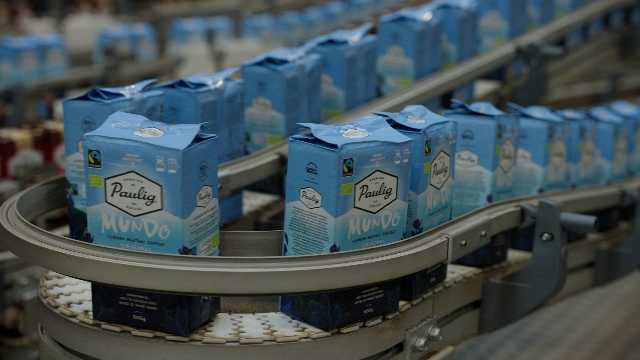
As early as 2017, Finnish coffee producer Paulig, in collaboration with Mondi, replaced part of the fossil polyethylene with bio-based PE. The packaging’s CO₂ footprint declined measurably. This first step effectively addressed the climate footprint without fundamentally modifying the packaging machine or packaging processes.
In 2024 came the leap to a mono-material, recycling-oriented structure for vacuum-packed ground coffee. The vacuum “brick” retained its shape, the oxygen barrier reached the target level, and the solution integrates into existing filling processes. In sum, the path from renewable feedstock to design-for-recycling was achieved in a way that preserved line speed, quality, and handling.
There is Scandinavian inspiration on secondary packaging as well. For a Swedish coffee brand, German packaging machine builder Meurer, together with Mondi, replaced plastic shrink film with the paper-based Ad/Vantage TrayWrap solution based on Mondi’s kraft paper–based Ad/Vantage StretchWrap. The solution secures twelve coffee packs on the tray. Pre-die-cut fold points provide stability, and four to six glue dots secure the bundle. Meurer has designed its Paper Hood Machine (PHM) for paper webs so manufacturers can adapt their existing operations instead of building a new line.
From Trial to Series Production
In practice, this means: for primary packaging, mono-structures can be steered toward recyclability; for secondary packaging, plastic can be substituted with paper. Thanks to combined material expertise and application engineering in both paper and plastics, Mondi can support both paths in a material-agnostic manner.
In-house barrier papers and film structures, printing and converting under one roof, and testing capabilities in the FlexStudios in Germany shorten the journey from trial to series production. This makes it possible to reconcile coffee enjoyment with recycling requirements.