

Share your coffee stories with us by writing to info@comunicaffe.com.
On the occasion of the annual event dedicated to promoting Italian gastronomic excellence, the Embassy of Italy in The Hague and the ICE/ITA Office of the Benelux have highlighted espresso coffee as an identity symbol of Made in Italy. Below, we read the words of Massimiliano Marchesi, Coffee Trainer, on the subject.
Italian Espresso takes center stage in Amsterdam: culture, history, and tasting during the Week of Italian Cuisine
by Massimiliano Marchesi
AMSTERDAM – As part of the Week of Italian Cuisine in the World, the Italian Embassy in Den Haagand the ICE/ITA Office for the Benelux celebrated Italian espresso coffee in Amsterdam as a symbol of national gastronomic culture.

The event, held on November 11 at the SMEG showroom in Amsterdam, with the technical support of the Guida dei Caffè e delle Torrefazioni d’Italia, a partner of the “Italian Coffee Style” campaign promoted by the Ministry of Foreign Affairs and International Cooperation.
The initiative gathered a wide audience, including representatives from Italian and Dutch institutions, journalists, food & beverage professionals, and Made in Italy enthusiasts. Attendees welcomed the opportunity to delve deeper into the culture of Italian espresso, exploring its history, preparation techniques, and sensory potential with great interest and curiosity.

The event opened with a welcome by Matthijs de Rooij, CEO of SMEG Netherlands, who warmly greeted the approximately 150 guests in attendance, including diplomats, institutional representatives, and local stakeholders.
This was followed by a speech from the Italian Ambassador to The Hague, Augusto Massari, who emphasized the strategic value of Italy’s gastronomic heritage, describing it as a key driver of the country’s economy and a vital identity marker to be promoted abroad. Events such as this, he noted, provide the opportunity to spread Italian taste culture in contexts where it is still relatively unknown, thereby contributing to strengthening Italy’s image worldwide.
The program continued with a presentation by Tindaro Paganini, Director of the ICE/ITA Office for the Benelux, who highlighted—with supporting data—the significance of trade relations between Italy and the Netherlands. He also emphasized the crucial role of the ICE/ITA Office in supporting Italian companies in their internationalization efforts within the Dutch market.
The introductory speeches were followed by a symbolic live cooking session: chefs Giuseppe Tarantino and Lucia Antonelli prepared traditional meat tortellini following the classic recipe from Emilia.
The tortellini were served with a Parmigiano Reggiano cream sauce, offering guests an authentic taste of regional Italian cuisine — a true expression of tradition, craftsmanship, and quality.
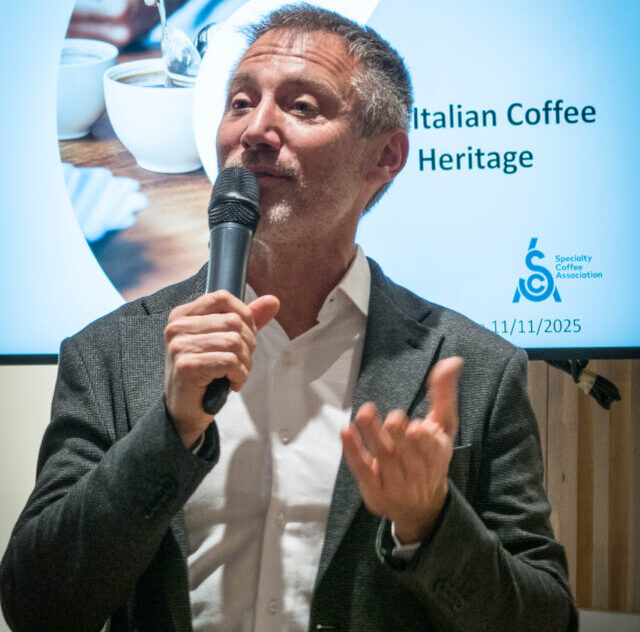
I then offered a more in-depth look at the social ritual of espresso in Italy — when, how, and why we drink it. In Italy, espresso is far more than a beverage; it is a daily ritual, a cultural and social habit, and often an excuse to meet, talk, or share meaningful moments. It is an identity symbol deeply woven into everyday Italian life.
Finally, I dedicated the closing part of my talk to the moka pot — the iconic coffee maker invented by Alfonso Bialetti, which revolutionized home coffee preparation in Italy starting in the mid-20th century. Still a symbol of Made in Italy and widely recognized abroad, the moka became the most common domestic brewing method for decades, producing a result close to espresso — long before the rise of coffee pods and home espresso machines.
Three different tastings
The evening concluded with a tasting of three espresso coffees. The blends selected, all made from 100% Arabica beans, were chosen to offer guests a diverse and engaging sensory experience.
The first, named Golden Sack, is a blend dominated by Brazilian Arabica, known for its pronounced sweetness and notes of honey, baked biscuits, and cereals.
The second, Organic Coffee, features a fresher and more delicate profile — a well-balanced cup where pleasant acidity blends harmoniously with a subtle bitter note, offering elegance and a clean finish on the palate.
Lastly, Mama Africa is a blend of Arabica beans sourced from various African countries, roasted darker to enhance its full body and long-lasting aromatic persistence, with a distinct hint of fresh licorice in the aftertaste.
The three blends, deliberately chosen for their contrasting origins, roast levels, and flavor profiles, were selected to let guests experience the remarkable variety of flavor, texture, and aroma that espresso can offer.
To accompany the tasting, another great icon of Italian pastry was served: Sicilian cannoli filled with a ricotta and coffee cream — a perfect way to conclude the tasting journey on a sweet note.
Experiences like this confirm the extraordinary potential of coffee as a vehicle for promoting Made in Italy, paving the way for new opportunities in collaboration and international outreach.
Massimiliano Marchesi