
Share your coffee stories with us by writing to info@comunicaffe.com.
Andrej Godina, PhD in science, technology, and economics in the coffee industry, shares his reflections after participating in the coffee promotion program at the Italian Embassy in Manila. The events were also organized in collaboration with the Italian Chamber of Commerce in Manila. Let’s read his thoughts below.
The italian coffee in the Philippines
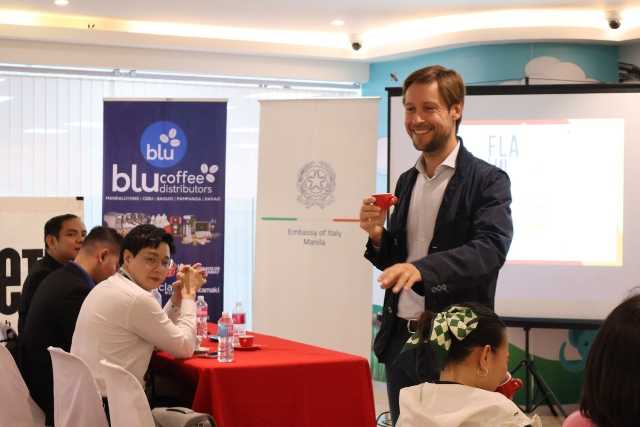
MANILA – “On November 4 and 5, I had the pleasure of actively participating in the first stop of the new Italian coffee promotion program “Italian Coffee Style”, promoted by the Italian Ministry of Foreign Affairs and International Cooperation. This strategic mission saw the Italian Embassy in Manila, led by Ambassador Davide Giglio, engaged in organizing two days of intensive cultural and educational activities, aimed at industry professionals, hospitality school teachers, media representatives, and local stakeholders.

Davide Giglio, Italian Ambassador to the Philippines: “I am particularly pleased that Prof. Andrej Godina began his collaboration with the MAECI here in Manila. The Philippines has a long-standing relationship with coffee, introduced by the Spanish at the end of the 18th century. The Italian coffee distribution chain has been steadily and successfully strengthening in the Philippines”.
Giglio: “The outlook for the sector is extremely positive: in Asia, Filipinos are second only to the Japanese in per capita consumption. Italian products — both roasted coffee and machinery — are perceived very positively in terms of quality. Certainly, this promotional initiative by the Ministry can open new paths of bilateral cooperation and contribute to a broader internationalization of Italian coffee in one of the most dynamic and fast-growing markets in the ASEAN region.”

My participation was requested as the editor of the “Guida dei caffè e delle torrefazioni d’Italia” and as an Italian Coffee Ambassador. My role was articulated in two main activities: a technical masterclass for hospitality school instructors in Manila, and an experiential lunch event titled “Italian Coffee Pairing”, organized in collaboration with the restaurant Grace Park.
Two complementary moments designed to narrate the value, the history, and the uniqueness of the Italian coffee supply chain — a world that blends tradition, craftsmanship, innovation, flavor, and culture.
The Italian Coffee and Roasteries Guide was chosen as a key cultural tool to highlight the complexity, history, and quality of Italian coffee. This editorial project, unique of its kind, reviews and selects the finest Italian roasteries, offering a comprehensive narrative of the production landscape and the industry’s excellence. It is precisely from this Guide that the Ministry chose to identify the Italian Coffee Ambassadors to be involved in international initiatives such as the one in Manila, entrusting knowledgeable professionals with the task of representing the many facets of Italian coffee culture through guided tastings and educational sessions.
Italian espresso in the classroom: training for Manila’s hospitality school teachers
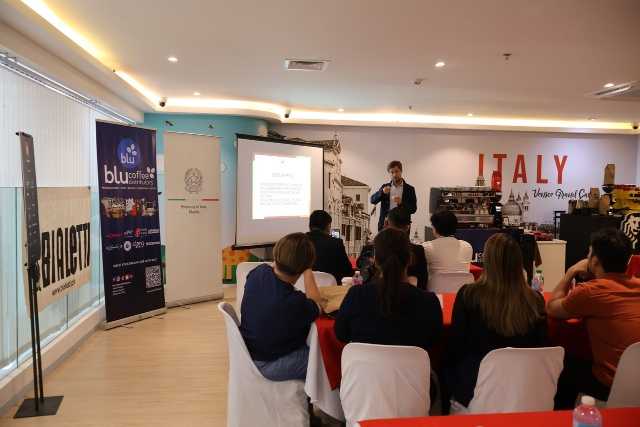
The Italian coffee masterclass I conducted on November 4 at the Italian Embassy in Manila was a high-level educational experience. It was attended by teachers from some of the most important hospitality schools in the Philippine capital – a highly qualified audience selected to become multipliers of Italian coffee culture among the next generation of food and beverage professionals.
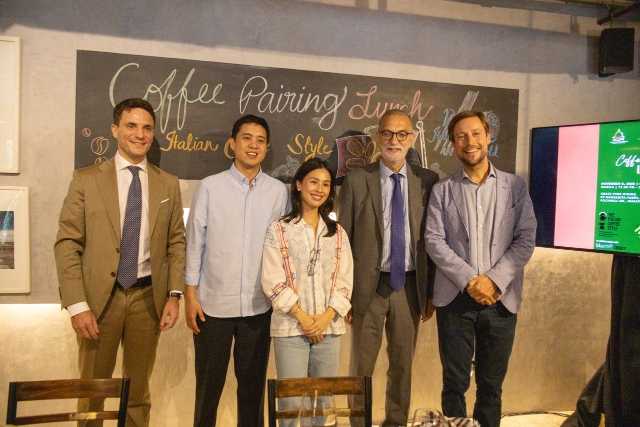
The event, strongly supported by Ambassador Davide Giglio and his team, took place in an atmosphere of authentic hospitality, with the Embassy transformed into a true immersive classroom, combining theoretical presentations and guided tasting sessions.
My lecture began with a historical journey, tracing the spread of coffee across Europe, from its arrival in Venice at the end of the 17th century to the opening of the first Italian coffee shops, the invention of the Napoletana pot, the Moka, and the lever espresso machine – the innovation that gave birth to the espresso we know today. We explored the evolution of coffee extraction technologies and how espresso became a central element of Italian 20th-century culture.
Alongside the traditional Moka – a domestic symbol still present in many Italian homes – I showcased the excellence of Italian technology and know-how in espresso extraction, emphasizing how Italy essentially invented a new beverage with its distinctive crema.
The practical tasting sessions guided participants through a sensory exploration of typical Italian coffee flavors.
We compared espresso extractions of blends made from Arabica and Robusta (Canephora) with Moka preparations, highlighting the art of blending, the importance of roast profiles, and the impact of extraction techniques on the final flavor.
I explained how the taste of Italian espresso is the result of historical and regional layers: lighter and more acidic in the North, more bitter, intense, and full-bodied in the South — a flavor balance that shifts from region to region.
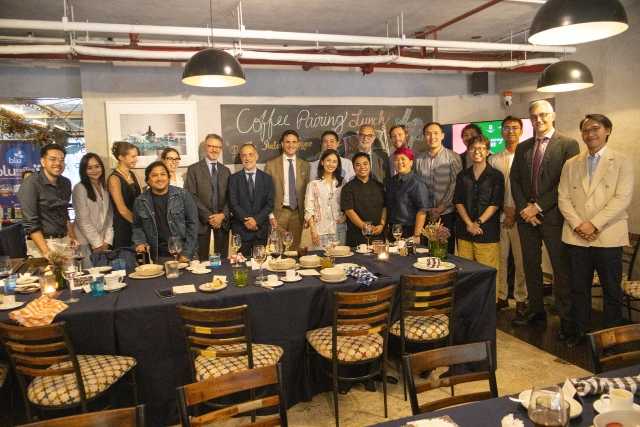
I also introduced the Guide to Italian Roasters, which was warmly received by the audience. Teachers saw its potential as an educational tool to use with their students for discussing coffee quality, flavor, and culture.
It was inspiring to see how much interest there is in our Italian model — not just as a final product, but as a cultural system to explore, study, and even replicate.
The session concluded with a lively exchange of questions and insights. We discussed coffee education, brewing recipes, sensory techniques, and roasting profiles. A strong desire emerged to build partnerships between Filipino hospitality schools and Italian training institutions — a bridge between cultures, forged through the shared language of coffee”.
Andrej Godina