

Share your coffee stories with us by writing to info@comunicaffe.com.
BONN, Germany – The Global Coffee Platform (GCP) has announced the recognition of three new sustainability schemes as equivalent to the Coffee Sustainability Reference Code (Coffee SR Code). The announcement reflects the momentum among GCP Members to use a shared reference point for credible, consistent approaches to coffee sustainability.
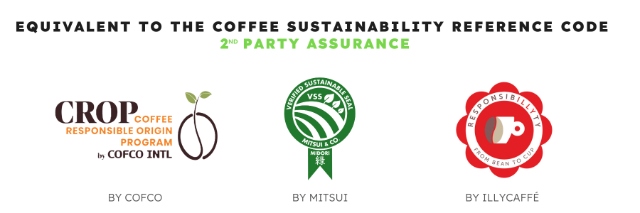
The three schemes – CROP by COFCO, VSS Midori Protocol by MITSUI, and Responsibillyty by illycaffé – are now recognized by GCP as equivalent to the Coffee SR Code, 2nd party assurance.
“The recognition of these schemes reflects the momentum we see amongst our members to align around a jointly developed concept of coffee sustainability. Through the GCP Equivalence Mechanism process, each of these companies has taken a thorough and thoughtful approach to demonstrating how their sustainability schemes align with the foundational principles and practices of sustainable coffee production and continuous improvement towards better outcomes for farmers, workers, and landscapes,” said Annette Pensel, GCP Executive Director

The schemes join 29 others after having completed the rigorous process, in which schemes are assessed on meeting at least the levels of the economic, social, and environmental principles of the Coffee SR Code, as well as important operational criteria laid out in the Equivalence Mechanism 2.0 such as governance, standard-setting, assurance, data management, and claims integrity.
This brings the total number of GCP-recognized sustainability schemes – either 3rd party or 2nd party assurance systems – to 32 .

“We welcome the commitment of these GCP Members to strengthening the consistency and transparency of sustainability efforts across the sector,” added Pensel. “Their participation contributes to a clearer, more comparable landscape for coffee sustainability.”
Sector alignment for coffee sustainability
“Achieving recognition reflects a rigorous and comprehensive process that demands a deep understanding of the Coffee SR Code and operational criteria, and a genuine commitment to strengthen existing practices” said Gabriel Chavez, GCP Manager Sustainable Sourcing.
“Equivalence not only confirms alignment with the baseline but also demonstrates readiness to continuously improve and drive sustainability across the coffee sector.”
Once again, GCP partnered with the International Trade Centre, creator of the Standards Map, to independently conduct the Equivalence Mechanism assessment, ensuring impartial and comprehensive evaluations.
The newly recognized schemes are eligible for participation in the Sustainable Coffee Purchases 2026 Report, to be published in 2027. Through GCP’s transparency initiative, the annual Collective Reporting, roasters and retailers report their sustainable coffee volumes using common metrics that that strengthen comparability, transparency, and accountability. The latest results will be presented in the upcoming Sustainable Coffee Purchases 2024 Report, expected later this year.
Together, the Coffee SR Code, Equivalence Mechanism, and Collective Reporting form a suite of assets developed by GCP to promote a globally aligned, credible and practical approach to foundational coffee sustainability that promotes inclusion and continuous improvement, while supporting members to advance their own sustainability goals.
“Every new recognition adds to a more reliable and aligned sustainability landscape. It’s encouraging to see companies invest in this process and in the robustness of their systems,” said Chavez.
“As GCP reviews and strengthens the Coffee SR Code and the Equivalence Mechanism in 2026, we invite GCP Members to actively contribute and encourage all actors to stay engaged in this collective effort. Given the changing landscape within coffee and beyond, this review is a key opportunity to shape an even stronger and more coherent global reference for sustainable coffee.”
This announcement marks the close of the current recognition cycle under the Equivalence Mechanism 2.0, as GCP and its members look ahead to the next chapter of aligning for collective action through the upcoming review of the Coffee Sustainability Reference Code and the Equivalence Mechanism, ensuring these tools continue to serve a dynamic and forward-looking sector.
List of sustainability schemes recognized by GCP as Coffee SR Code equivalent at the time of publication
3rd party assurance system:
- 4C
- Fairtrade International, Small Producer Organization and Coffee Standard
- Fair Trade USA’s Agriculture Production Standard
- Rainforest Alliance Sustainable Agriculture Standard
2nd party assurance system:
- Agri Evolve’s ACE
- Comexim’s Green Trace
- Coocacer’s Café Sustentável
- Cooxupé’s Gerações
- COFCO’s CROP
- ECOM’s SMS Verified
- Enveritas’ Enveritas Green
- Expocacer’s ECO
- Exportadora de Café Guaxupé’s Guaxupé Planet
- HACOFCO’s CONNECT
- illycaffé’s Responsibillyty
- Louis Dreyfus Company’s Responsible Sourcing Program Advanced
- Minasul’s LEGACY Protocol
- MITSUI’s VSS Midori Protocol
- Montesanto Tavares Group’s GMT Green
- Nespresso AAA Sustainable Quality™ Program
- Neumann Kaffee Gruppe’s NKG BLOOM, and NKG Verified
- ofi’s AtSourceV, and AtSource+
- Perhusa’s ARTS
- Racafé’s CRECER
- 3E by RGC Coffee
- Touton’s PACT
- Volcafe’s Volcafe Verified, and Volcafe Excellence
- Westrock Coffee Company’s RAÍZ Sustainability