


Share your coffee stories with us by writing to info@comunicaffe.com.
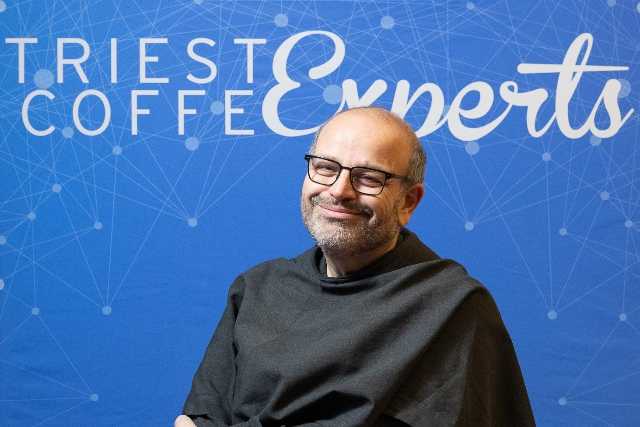
TRIESTE, Italy – Every technology introduces a form of power. And today, artificial intelligence is already deciding who controls the fruits of our work.” With this reflection, Father Paolo Benanti, Franciscan theologian and leading expert in the ethics of innovation, opened the 2025 edition of the Trieste Coffee Experts, the international summit conceived by the Bazzara family, which once again brought to Trieste key players from across the global coffee value chain.
Within the framework of Trieste Coffee Experts – Coffee Megatrends, a platform designed to foster strategic dialogue between industry, institutions and culture, Benanti placed at the center of the discussion a theme that goes far beyond technology itself: economic and industrial governance in an era where even traditional sectors such as coffee are becoming increasingly “software-defined.”

Benanti – advisor to the United Nations, the Vatican and the Italian Government, and professor at LUISS Guido Carli University and Seattle University – explained how the nature of value creation is shifting.
“Today, products are no longer defined solely by their material components,” he noted, “but by the software that governs them. We buy the hardware, but the software remains under license. This means that value — and often decision-making power — moves elsewhere.”
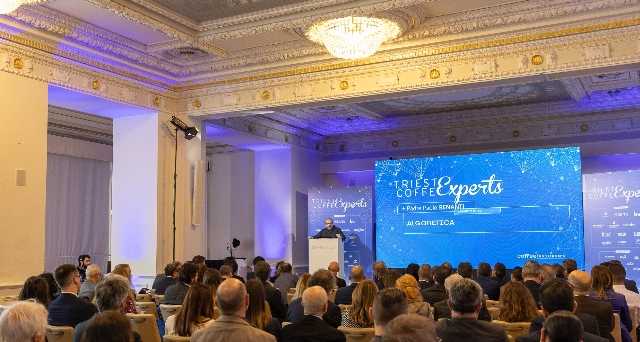
A dynamic already evident in smartphones and the automotive industry, and now increasingly relevant to the coffee sector: from espresso machines equipped with chips and sensors to digital platforms that collect and analyze consumption data throughout the supply chain.

According to Benanti, the risk is clear. In the short term, turnkey solutions may appear efficient and cost-effective; in the medium to long term, however, they can lead companies to outsource not only processes, but also control over margins and strategic autonomy.
“If this transformation is not governed,” he warned, “we risk losing not only control over production, but also over the economic value generated by our work.”
Alongside these critical issues, artificial intelligence also opens up significant opportunities. When applied to production, AI can enhance quality, reduce waste, optimize energy consumption and preserve skills that might otherwise be lost.
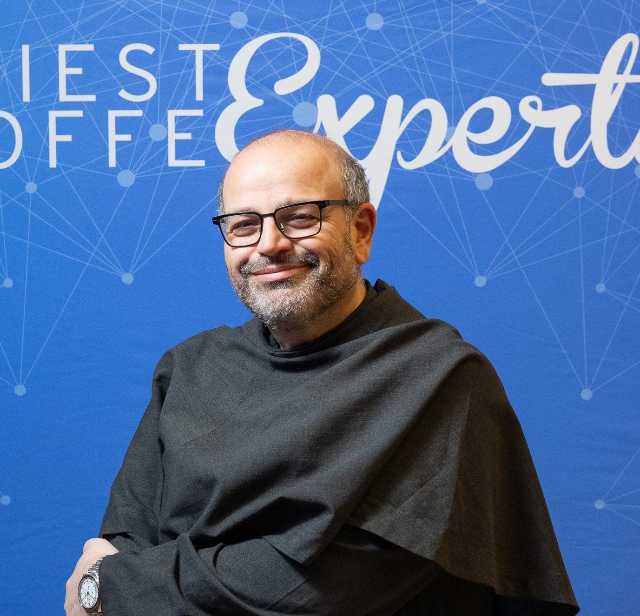
“The datafication of processes,” Benanti explained, “enables new forms of research and development, including cooperative models between companies, reducing dependence on large external technology players.”
Another key area concerns consumption and service. AI can help deliver high-quality coffee experiences even in the absence of a skilled barista, expanding consumption occasions and creating new markets.
“Intelligent interfaces,” Benanti observed, “can translate consumer language into product choices, personalizing the offer and redistributing value along the entire supply chain.”
Energy, however, remains a crucial variable.
“Artificial intelligence does not exist in the abstract — it lives in data centers,” he reminded the audience, “and it consumes enormous amounts of electricity.” In some U.S. regions, such as Ohio, the rapid expansion of data centers has led to electricity price increases of up to 77% in a single year.
“In Europe, where energy costs are already high, this risk could translate into additional mark-ups on products, potentially pushing excellence-driven supply chains like Italian coffee out of the market.”
Benanti’s concluding message was a call for governance and responsibility.
“This is not about stopping innovation,” he said, “but about negotiating its development through an ethical framework that protects those who generate value.” A principle he defines as “Algor-ethics”: an approach to artificial intelligence designed to support human work, rather than weaken it.
About Father Paolo Benanti
Paolo Benanti is a Franciscan friar, theologian and internationally recognized expert in the ethics of technology and artificial intelligence.
He advises the United Nations, the Holy See and the Italian Government on issues related to AI, digital governance and the future of work.
He teaches at LUISS Guido Carli University (Rome) and Seattle University, and is a frequent contributor to public debates on the social, economic and ethical implications of technological innovation.
Benanti is also known for developing the concept of Algor-ethics, an ethical framework aimed at aligning artificial intelligence with human dignity, sustainability and shared value creation.